What is the difference between speed and velocity? Explain with an example.
Published on November 3rd, 2025
Hey everyone!
So, I'm writing this post because this is a topic that confused me for the longest time: Speed vs. Velocity.
In normal life, we pretty much use them to mean the same thing. We say "the car's speed is 60 km/h" or "the car's velocity is 60 km/h," and nobody bats an eye.
But in our physics class, I learned that mixing these up is a huge mistake. Our teachers drill this into us because for JEE and NEET, getting this wrong can mess up an entire kinematics problem. It's like the most basic, fundamental thing.
I finally had that "aha!" moment, so I wanted to share my notes on it. Here's the simple way I remember it.
The Entire Difference in ONE Word
If you only remember one thing, remember this. The entire difference between speed and velocity is one simple word: Direction.
-
Speed just cares about "how fast" you are.
-
Velocity cares about "how fast" you are and "where you are going."
In physics language, this is what our teachers mean when they say "scalar" and "vector."
-
Speed is a Scalar Quantity: This is just a fancy way of saying it's a number. It only has a size (or "magnitude").
-
Examples: 10 m/s, 50 km/h, 30 mph.
-
-
Velocity is a Vector Quantity: This means it has both a size and a direction.
-
Examples: 10 m/s East, 50 km/h upwards, 30 mph due North.
-
You MUST Understand This First: Distance vs. Displacement
Okay, before we get to the formulas for speed and velocity, we have to quickly talk about Distance vs. Displacement. Our sir said if you don't get this, you'll never get speed vs. velocity.
-
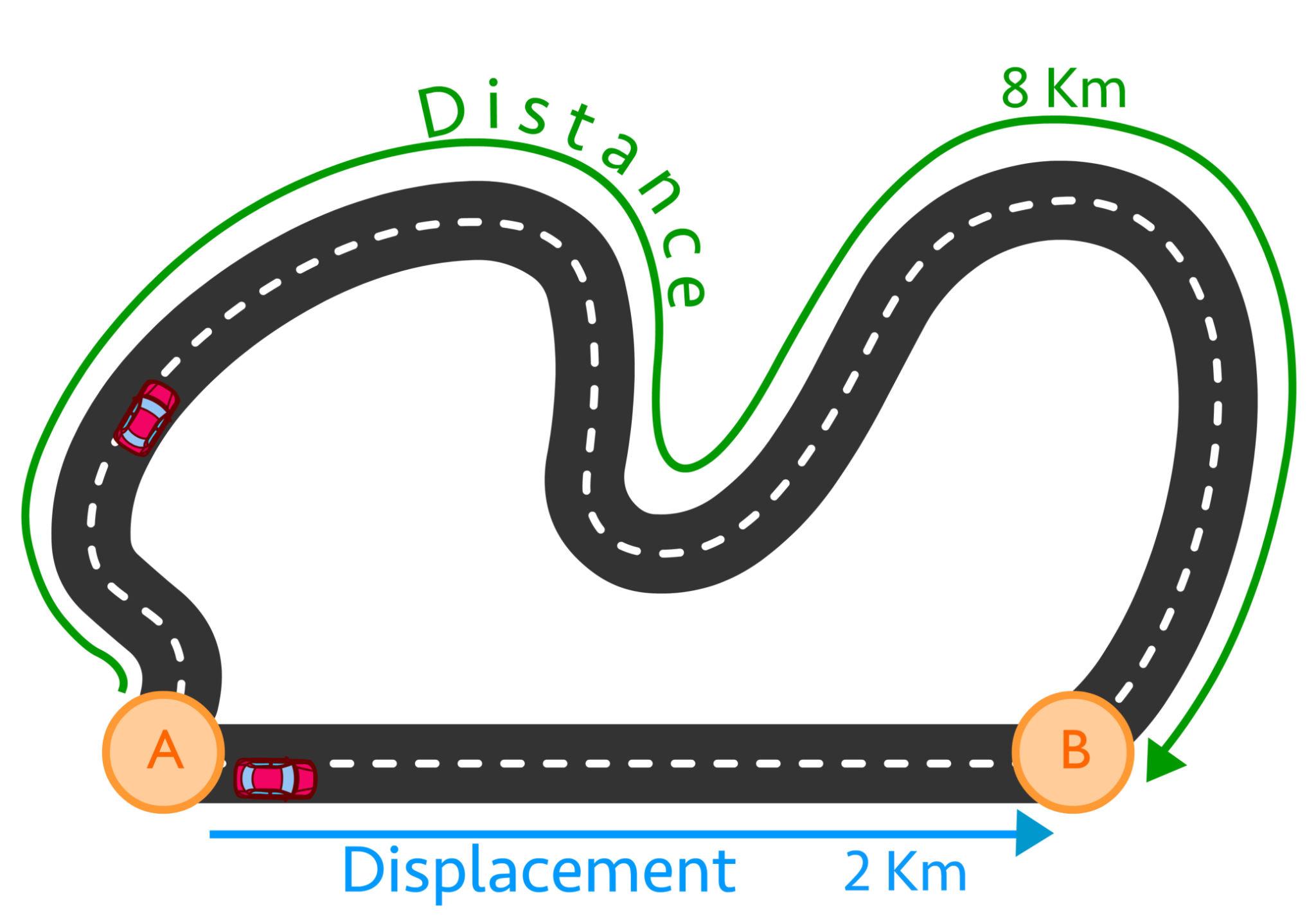
Distance (Scalar): This is the total path you actually walked. If you walk 4 meters East and then 3 meters North, your total distance is $4 \text{ m} + 3 \text{ m} = 7 \text{ m}$.
-
Displacement (Vector): This is the shortest straight-line path from your start to your finish. It doesn't care about the path you took, just where you started and where you ended.
Let's use the same example:
-
You walk 4 meters East.
-
You walk 3 meters North.
Your distance is $7 \text{ m}$.
But your displacement is the hypotenuse of that triangle. We can use the Pythagorean theorem ($a^2 + b^2 = c^2$).
So, $4^2 + 3^2 = 16 + 9 = 25$. The square root of 25 is 5.
Your displacement is 5 meters in the North-East direction.
See? The distance you walked (7 m) is different from your displacement (5 m).
The Formulas (Now They Make Sense!)
Now that we know the difference between distance and displacement, the formulas for speed and velocity are super easy.
Average Speed uses Distance.
Average Velocity uses Displacement.
The Best Example (My "Aha!" Moment)
This is the example that made it all click for me.
Imagine an athlete running on a 400-meter circular track.
-
They start at point A.
-
They run one full, complete lap, returning to point A.
-
It takes them 80 seconds.
Let's find their average speed and average velocity.
1. Average Speed:
-
Formula: $\text{Average Speed} = \frac{\text{Total Distance}}{\text{Time}}$
-
Total Distance: They ran one full lap, so the distance is $400 \text{ m}$.
-
Time: $80 \text{ s}$.
-
Calculation: $\text{Average Speed} = 400 \text{ m} / 80 \text{ s} = 5 \text{ m/s}$.
-
So, their average speed was 5 m/s.
2. Average Velocity:
-
Formula: $\text{Average Velocity} = \frac{\text{Total Displacement}}{\text{Time}}$
-
Total Displacement: Wait... they started at point A and finished at point A. Their starting point and ending point are the same! This means their displacement is 0 meters.
-
Time: $80 \text{ s}$.
-
Calculation: $\text{Average Velocity} = 0 \text{ m} / 80 \text{ s} = 0 \text{ m/s}$.
How crazy is that?
The athlete was running fast (with a speed of 5 m/s), but their average velocity for the whole lap was 0 m/s. This is because velocity only cares about the change from start to finish, and there was no change.