Difference Between Distance and Displacement: Definition, Formula, Units & Examples
Published on February 10th, 2026

In physics, some concepts look very simple at first but create confusion when you go deeper. Distance and displacement are perfect examples of this.
Students often feel both mean the same thing because both are related to motion and movement. But in physics, distance and displacement are two very different quantities.
This topic is extremely important for Class 9, 10, 11 and 12 Physics, and it is also a base concept for JEE, NEET, NTSE and Olympiads. If you understand this chapter properly, many future topics like speed, velocity, acceleration and motion graphs become much easier.
Let’s understand the difference between distance and displacement step by step, with simple explanations and real-life examples.
What Is Distance?
 |
 |
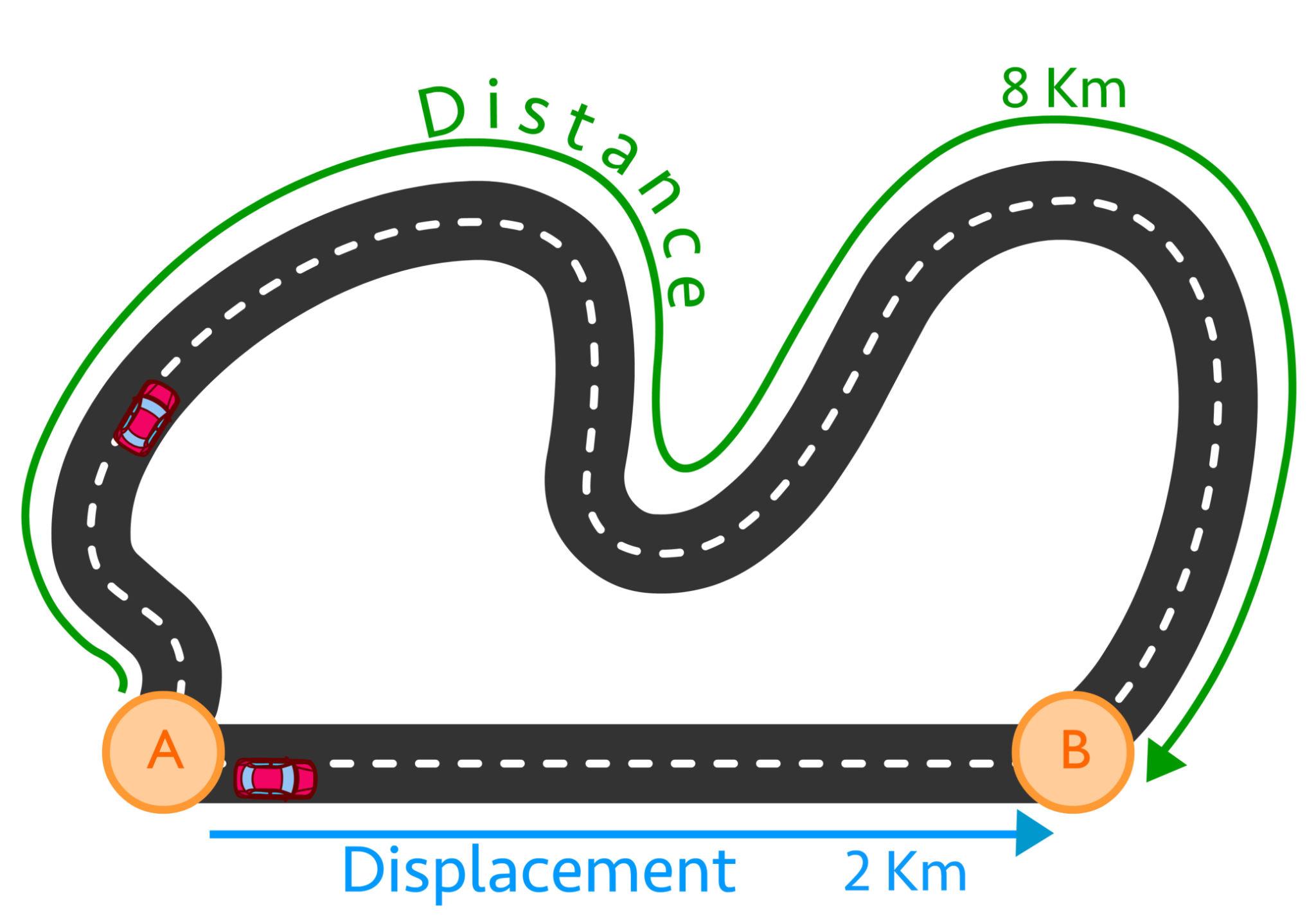
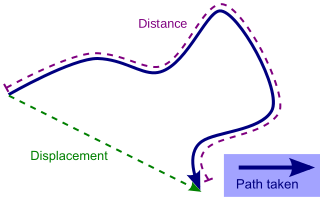
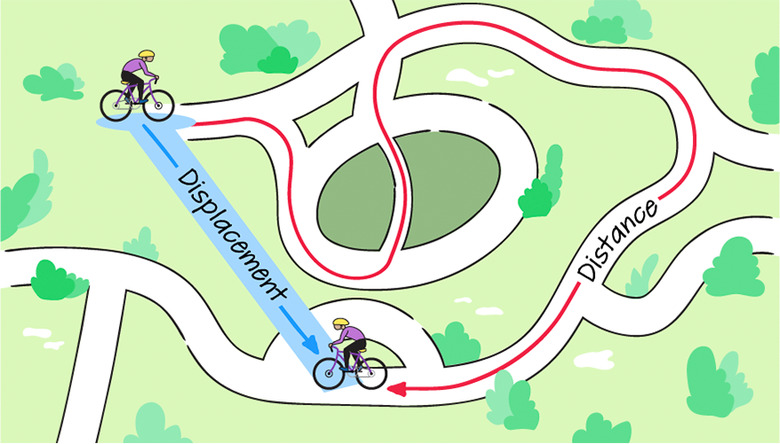
Distance is the total length of the actual path travelled by an object, irrespective of the direction.
In simple words, distance tells us how much ground an object has covered during its motion.
Key Points About Distance
-
Distance depends on the actual path taken
-
It does not consider direction
-
Distance is always positive
-
Distance is a scalar quantity
SI Unit of Distance
-
Metre (m)
Example of Distance
Suppose a person walks:
-
4 meters east
-
Then 3 meters west
The total distance travelled will be:
$4 + 3 = 7\,\text{meters}$
Distance simply adds up the path, without caring where the person ends up.
What Is Displacement?
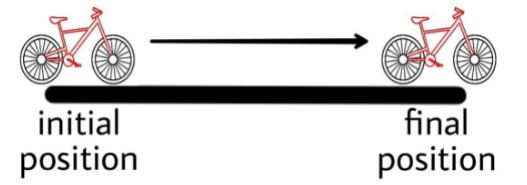
Displacement is the shortest straight-line distance between the initial position and the final position of an object, along with direction.
Displacement focuses only on where the object started and where it ended, not on how it moved in between.
Key Points About Displacement
-
Displacement depends on initial and final positions
-
Direction is very important
-
Displacement can be positive, negative, or zero
-
Displacement is a vector quantity
SI Unit of Displacement
-
Metre (m)
Example of Displacement
Using the same example:
-
4 meters east
-
3 meters west
The final position is 1 meter east from the starting point.
So, displacement = 1 meter east.
Distance vs Displacement: Scalar and Vector Concept

One of the most important differences between distance and displacement lies in their nature.
-
Distance is a scalar quantity, which means it has only magnitude
-
Displacement is a vector quantity, which means it has both magnitude and direction
This difference is very important for:
-
Board exam definitions
-
MCQs in competitive exams
-
Understanding velocity later
Difference Between Distance and Displacement (Tabular Form)

| Basis | Distance | Displacement |
|---|---|---|
| Definition | Total path travelled | Shortest distance between start and end |
| Type | Scalar quantity | Vector quantity |
| Direction | Not considered | Always considered |
| Path dependency | Depends on actual path | Depends only on position |
| Value | Always positive | Can be positive, negative, or zero |
| SI unit | Metre (m) | Metre (m) |
| Zero value | Cannot be zero if motion occurs | Can be zero |
| Magnitude | Always greater than or equal to displacement | Less than or equal to distance |
This table is very frequently asked in exams for 3–5 marks.
Can Distance Be Zero?
Distance becomes zero only when the object does not move at all.
If there is any motion, distance will always have a positive value.
Can Displacement Be Zero?
 |
 |
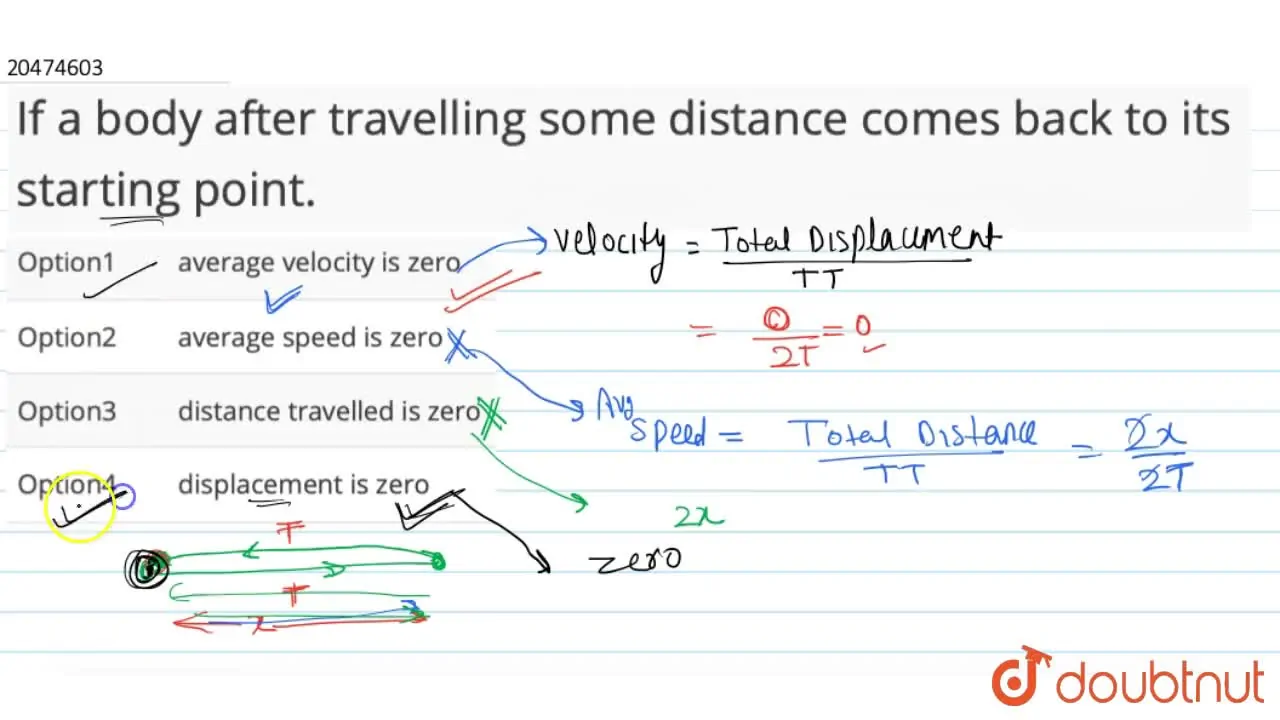 |
Yes, displacement can be zero even when the object has moved.
Example:
If a student walks from home to a park and comes back home:
-
Distance travelled ≠ 0
-
Final position = Initial position
-
Displacement = 0
This is one of the most important conceptual questions asked in exams.
Distance and Displacement in Circular Motion
 |
 |
Consider a person completing one full round of a circular track.
-
Distance travelled = circumference of the circle
-
Displacement = 0 (because starting and ending points are same)
This example is extremely useful for numericals and MCQs.
Formula Related to Distance and Displacement
Distance and displacement do not have direct formulas like speed or velocity.
However, they are used in formulas such as:
-
Speed = Distance / Time
-
Velocity = Displacement / Time
Understanding the difference helps students avoid mistakes when solving problems.
Why Distance Is Always Greater Than or Equal to Displacement
-
Distance measures the actual path
-
Displacement measures the shortest possible path
The shortest distance between two points is always a straight line, which is why:
$\text{Distance} \ge \text{Displacement}$
Importance of Distance and Displacement in Exams
Board Exams
-
Definitions
-
Differences
-
Numerical problems
-
Assertion-reason questions
Competitive Exams (JEE / NEET)
-
Conceptual MCQs
-
Graph-based questions
-
Motion analysis problems
A clear understanding of this topic helps in:
-
Motion in one dimension
-
Motion in two dimensions
-
Relative motion
Common Mistakes Students Make
-
Writing direction for distance
-
Ignoring direction in displacement
-
Assuming displacement is always equal to distance
-
Forgetting displacement can be zero
-
Confusing speed with velocity
Avoiding these mistakes can significantly improve exam scores.
Quick Revision Points
-
Distance = total path travelled
-
Displacement = shortest straight-line distance
-
Distance is scalar
-
Displacement is vector
-
Distance ≥ Displacement
-
Displacement can be zero
Conclusion
The difference between distance and displacement is one of the most fundamental concepts in physics. Distance tells us how much ground an object has covered, while displacement tells us how far and in which direction the object has moved from its starting point.
Once this concept is clear, topics like speed, velocity, acceleration, and motion graphs become much easier to understand. This clarity is essential not only for scoring well in exams but also for building a strong foundation in physics.
